
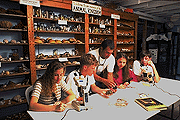
Lab
Studies
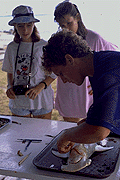
Shark
Disection
Jeopardy
© Copyright Seacamp Assoc. Inc. All Rights Reserved





OUR PROGRAMS - MARINE
INVESTIGATIONS
CORAL ECOLOGY - NEARSHORE ECOLOGY - COASTAL
ECOLOGY
EVENING
PROGRAMS - VAN TRIPS
MARINE INVESTIGATIONS-
LABS/SNORKELING/WADING
TRIPS AT NHMI- DAYTIME PROGRAM #3
Fouling Communities
Lesser-known invertebrates such
as hydroids, tunicates and bryozoans thrive on submerged docks and
pilings. Students closely examine these fouling organisms.
Shark Ecology
Hands-on activities, a
question and answer session, and a chance to observe sharks make
this a favorite program of students and teachers.
Cassiopeia Lab
Cassiopeia
(Upside-down jellyfish) are collected and then exposed to changes
in physical conditions that occur in their natural habitat.
Students monitor changes in pulsation rate, record and analyze
data and then release the jellyfish.
Sponge
Community
Within the myriad canals of many sponges live
hundreds of invertebrates. Students examine the canals and observe
and record the creatures found within them. Annelid worms and
snapping shrimp are some of the most common inhabitants.
Fish Anatomy
External and internal
anatomy of bony fishes are discussed and examined. Activities may
include fish printing (on tee shirts or paper), fish dissection
(for older students) and comparisons between bony and
cartilaginous fishes.
Animal Behavior
Students collect animals such as fiddler crabs, segmented worms
and sea stars ("starfish") and design experiments to
monitor various behaviors, including defense, feeding,
reproduction and competition.
Squid
Anatomy
External and internal anatomy of cephalopods
will be discussed and examined. This dissection lab is one of the
most popular marine investigations.